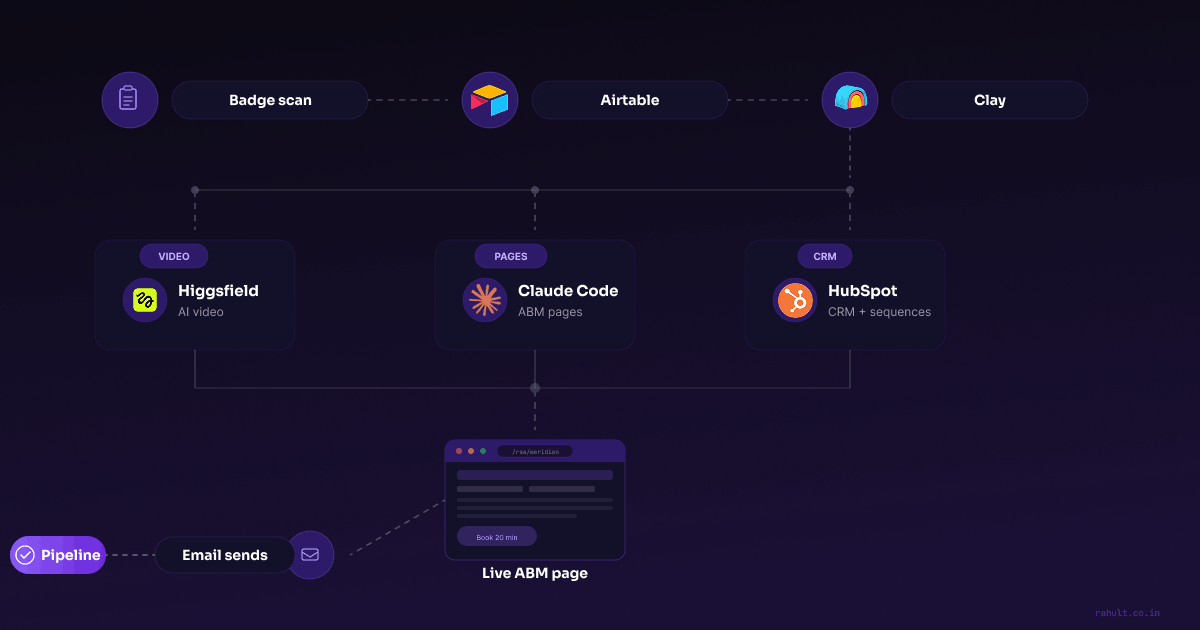
I spent years waiting on engineering.
Not because they were slow. Because I needed things built that required skills I didn't have. A custom integration. A data pipeline. A workflow that connected our CRM to a tool that didn't have a native connector.
The request would go into a sprint. Weeks would pass. By the time it shipped, the campaign had launched without it.
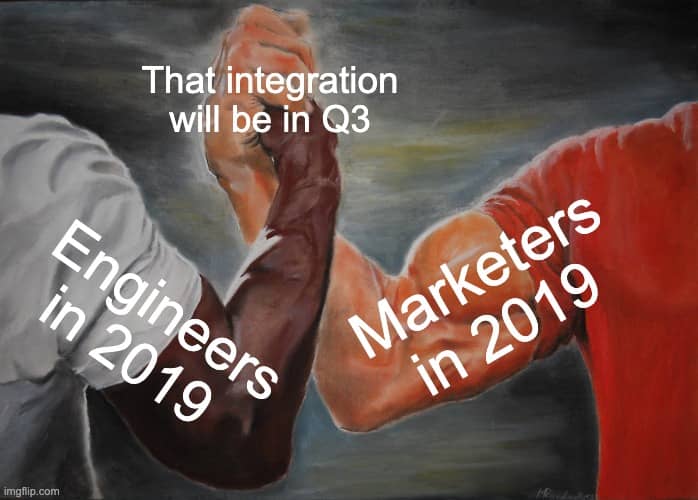
That was the deal. Marketing has ideas. Engineering makes them real. The division felt permanent.
Then the ground shifted.
The pattern we've seen before
Every decade or so, something changes in how companies sell, and the org chart bends to accommodate it.
In 1931, Procter & Gamble created the Brand Man role. One person accountable for one product's entire go-to-market. Novel at the time. Now it's so embedded we forget it was invented.
In the 1980s, technology companies realized they needed someone who could translate product capabilities into buyer value. Product Marketing Manager emerged as a distinct function.
In the 2010s, revenue operations appeared. Companies were drowning in tools. Someone needed to own the stack, the data, and the handoffs between marketing, sales, and customer success. SiriusDecisions research showed companies with aligned revenue operations grew three times faster than those without.
Each shift followed the same arc. New complexity creates new problems. New roles emerge to solve them. The org chart adapts.
We're in another one of those moments.
What I'm seeing now
Three data points that stopped me mid-scroll.
First: Bloomberry analyzed over 1,000 GTM engineering job postings and found 205% year-over-year growth in 2025. By January 2026, over 3,000 open roles on LinkedIn.
Second: PwC's 2025 Global AI Jobs Barometer showed AI-skilled workers command a 56% wage premium over similar roles without AI skills. That's double what it was the previous year.
Third: Gartner predicts that by 2027, a lack of AI literacy will rank among the top three reasons CMOs are replaced at large enterprises. Not digital marketing skills. Not demand gen performance. AI literacy.
Something is moving fast.
What companies are actually hiring for
I went through 50+ job postings to understand what's actually being asked for. The pattern became clear quickly.
The tools are converging. Clay appeared in over 80% of postings. Then HubSpot, Outreach, Salesforce, and Zapier. The stack isn't growing; it's consolidating around platforms that enable automation without engineering dependencies.
Technical skills are table stakes. This is what stopped me cold: SQL and Python appeared in 38% of postings. Not "nice to have." In the requirements section. The median salary sits at $127,500, but roles requiring code push well above $180K.
This isn't an entry-level play. Average experience required: 4.11 years. These aren't junior hires with new titles. Companies want people who understand how revenue actually flows, then can build systems to accelerate it.
It's not about cold calling. Only 1.4% of postings mentioned outbound calling. This is a building role, not a dialing role.
What changes when one person can do what teams couldn't
Here's where this gets real.
Verkada's growth team automated 80% of their SDR workflows. Their MDRs now only engage on responses. Result: 120 meetings per month per rep versus the typical 20. That's not incremental improvement. That's 4x output with the same headcount.
Rippling doubled their cold email performance year over year using a 30-person growth team running Clay workflows.
Ramp, Notion, Intercom, and others have built entire GTM engineering functions. At Vanta, they created a role called "Founder in Residence for GTM Innovation" explicitly focused on finding ways AI can transform how they sell.

The common thread: these aren't cost-cutting exercises. They're leverage plays. Make every person's output multiply rather than hiring more people doing the same thing.
The most empowering time to be a marketer
Here's the thing that took me a while to internalize.
Technology was never within reach for marketers before. We had ideas, but we had to rely on vendors to create generic solutions for generic problems. The vendor built one integration that kind of worked for everyone but perfectly for no one. The IT team built what was already on the roadmap, not what your campaign needed next week.
Now this is the time where every team, every person can use technology and AI to create solutions for their specific problem. Not a generic template. Not a workaround. The actual thing you need, built by you, shipped the same day.
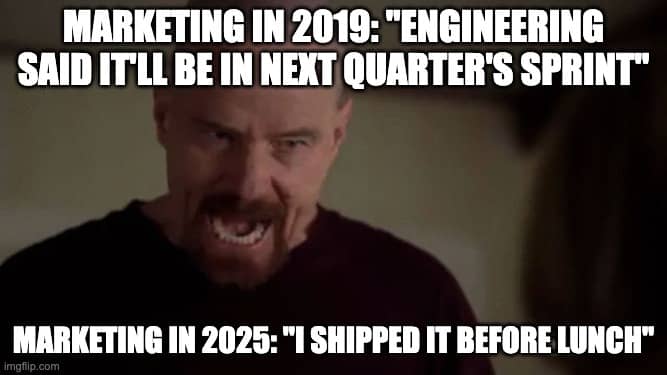
I genuinely believe this is one of the most empowering times to be a marketer. Or honestly, for anyone out there willing to build.
Where the gap is widening
Not everyone sees this the same way.
BCG's research found that 60% of organizations generate no material value from AI despite substantial investment. Only 5% are "future-built," meaning they've developed the capabilities to make AI work at scale.
The companies in that 5% aren't just adopting tools. They're redesigning how work happens. They're asking: what if this process didn't require manual handoffs? What if this workflow ran continuously without someone triggering it? What if the data moved itself to where it needs to be?
The other 60% are adding AI to existing processes without changing the processes. The tool is new. The bottleneck is the same.
The five layers this role requires
After going through these postings and talking to people doing this work, I started mapping what the role actually demands. Not the job description version. The real version.
Layer 1: Marketing Foundation
You still need to understand how B2B marketing works. What an MQL means. How leads flow from first touch to closed-won. Why certain campaigns convert and others don't. Without this, you're just building automations that look impressive but don't move numbers.
Layer 2: Cross-Functional Fluency
This is what separates tool operators from people who actually transform how a company works. How does sales really use the leads marketing sends? What does customer success need to reduce churn? Where does product data create signals marketing should act on? The best people in this role spend as much time with other teams as their own.
Layer 3: Tool Proficiency
Clay, HubSpot, Salesforce, Outreach. Zapier, Make, n8n for workflow automation. Snowflake or BigQuery if you're touching data at scale. You don't need to master all of them. But you need to understand how data flows between systems and where it gets stuck.
Layer 4: AI Skills
Prompt engineering that produces consistent outputs. Knowing when AI helps versus when it creates more problems. Building workflows that incorporate LLMs reliably. At the higher end, building agents that research accounts, qualify leads, or route requests with minimal human intervention.
Layer 5: Creativity
This is the layer people underestimate. Seeing connections others miss. Finding the automation opportunity nobody thought to look for. Recognizing that the friction in a sales process isn't a training problem, it's a data problem you can engineer away.
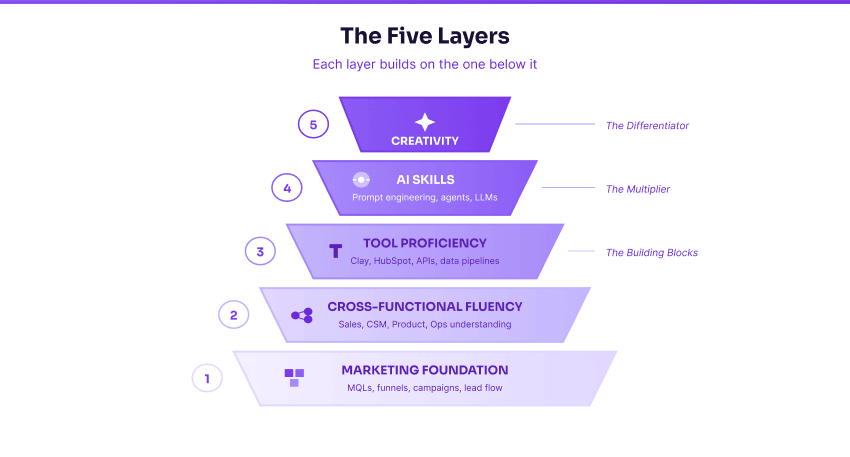
The postings I analyzed cluster around layers 3 and 4. But the people getting paid $200K+ operate across all five.
You can't skip layers. The automation amplifies whatever understanding you bring.
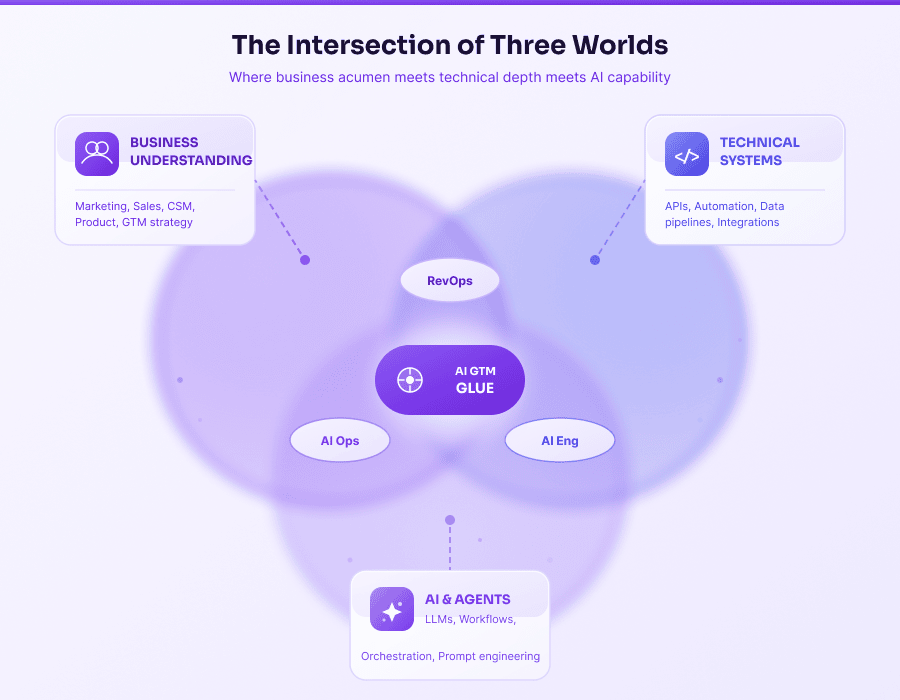
AI Glue in Marketing
Here's how I've started thinking about this role.
Every company has the same problem. Marketing generates leads but doesn't know what happens after handoff. Sales closes deals but context gets lost before renewal. Customer success sees churn signals but that data never reaches the teams who could act on it. Product hears feature requests in five different places but nobody connects them.
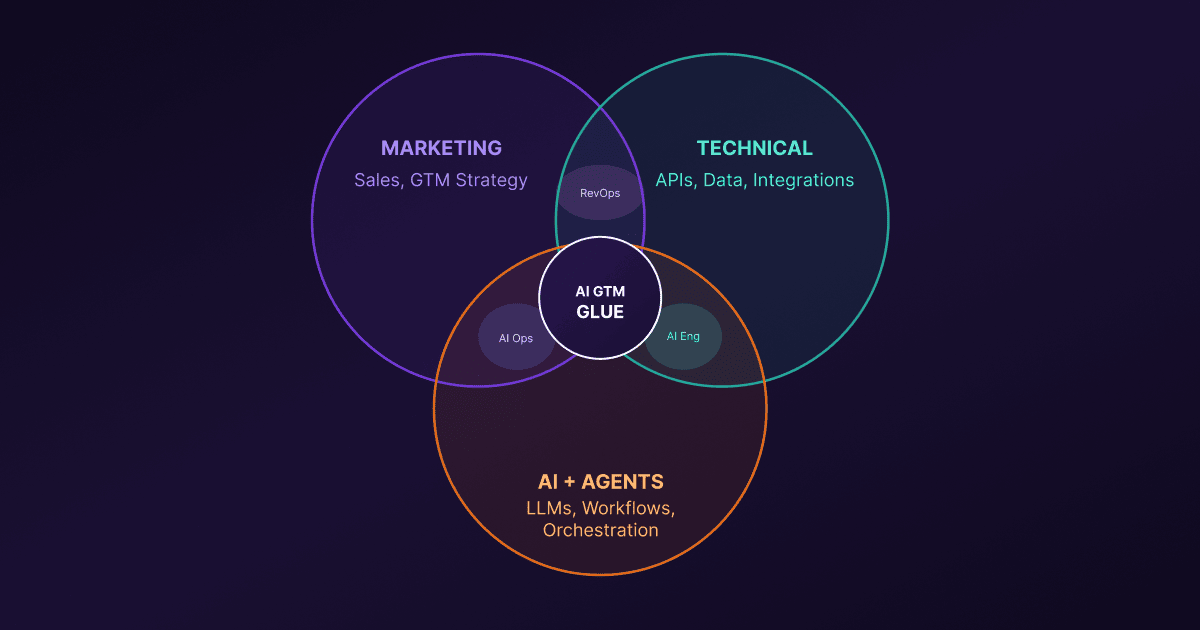
The AI Glue sits in the middle of all of it.
Not to own any single function. But to understand how they connect, find where things break, and build systems that fix the gaps. The person who can sit with sales for a morning, understand their actual workflow (not the CRM version), and ship an automation that afternoon. The person who notices that support tickets contain intent signals marketing has never seen.
Technology is what makes this possible now. One person with the right tools can connect what used to require a cross-functional initiative and a six-month roadmap.
That's the shift. Not engineers entering marketing. Marketers becoming the connective tissue across the entire go-to-market motion.
The question I'm sitting with
The trend is undeniable. 205% job growth. Over 3,000 open roles by January 2026.
But the question that keeps coming back to me:
How fast will organizations actually move? Will this become a standard hire within two years? Will marketers who resist technical skills find themselves competing against those who didn't?
The pattern has repeated before. Brand management. Product marketing. Revenue operations. Each time, the org chart changed to accommodate new complexity.
This time, the complexity is AI. And the org chart is changing again.
The only variable is adoption speed.
This is The Belief. Ideas that will shape marketing before they become obvious.