
The idea
I used to work at a cybersecurity company.
Every year before RSA, we'd have the same meeting. Same whiteboard. Same debate.
"What if we did socks this year?" "Stress balls are overdone." "What about a hoodie with our logo... but subtle?"
We'd spend weeks on this. Vendor calls. Sample shipments. Budget negotiations. Last-minute panic orders when the first batch came out wrong.
All to create swag that wouldn't end up in a junk drawer.
And I mean it, that was the actual goal. Not "drive pipeline." Not "generate leads." Just... please don't throw this away.
The bar was that low.
The RSA Reality
Here's what actually happens at RSA.
600+ exhibitor booths. Every vendor competing for attention. The average attendee walks out with somewhere between 40-50 pieces of swag. I've counted.
Stress balls. Pens. Notebooks. Socks with company logos. USB drives shaped like things that should not be USB drives (ironic for a cybersecurity conference, but I digress).
Your swag ends up in a bag with 46 other items. The prospect goes back to their hotel. They dump the bag in the corner. They fly home. The bag sits unopened for two weeks. Eventually, most of it ends up in a drawer. Or the trash.
And the leads? They go into the CRM. An SDR sends a templated email. "Great meeting you at RSA!" No context. No memory of who this person even is.
The prospect doesn't remember your booth. They definitely don't remember your swag. They delete the email.
This is the cycle. Every conference. Every year.
Then I Saw What Jazz Did
Jazz is a cybersecurity company. At RSA, they posted something that made me stop scrolling.
"It's feeding season at RSA. Your bag is full, but your soul is empty. So. Many. Useless. Pens."
They set up what they called a "Pawn Shop" at the conference. The idea: bring in your boring swag from other vendors, trade it for premium gear from Jazz. And here's the kicker — the exchange was your ticket into Jazz Night. Secret door. Live jazz band. Intimate vibes.
It's not just clever swag. It's an experience. It's a pattern interrupt. People will remember Jazz because Jazz understood something: the swag isn't the gift. The memory is the gift.
The Spark
And that made me wonder...
What if you took this a step further?
What if the swag wasn't just memorable at the booth, but became the trigger for an ABM outreach that actually lands?
What if you designed swag tied to specific ICPs? Tracked who got what at the booth? Segmented your leads by swag type? Built personalized ABM pages that reference the exact item they picked up? And sent those pages the next morning, from the rep they actually met, while they're still at the conference?
What if the swag was the first chapter of a story, not the whole story?
I started building this out. Here's the full framework.
The Two Swags: A and B
Before we dive into the framework, let me make the swag strategy concrete. You need two distinct swag items — each tied to a specific ICP. The swag choice IS the segmentation.
Noise-Canceling Headphones
"Finally. Silence."
For: Security Engineers, SOC Analysts, DevSecOps
These people are drowning. 10,000 alerts a day. 99% are noise. They're exhausted from chasing false positives. They dream about silence. The headphones are the metaphor. Your tool cuts through the noise.
The 3AM Kit
"For the night you finally don't get the call."
For: CISOs, VPs of Security, Directors
A small premium box containing a silk sleep mask, lavender pillow spray, earplugs. Every security leader knows the dread — the 3am breach notification. The scramble. The board meeting. They never fully sleep. The kit is the metaphor. Your tool lets them rest.
Throughout this post, when I say Swag A, I mean the Headphones (for practitioners). When I say Swag B, I mean the 3AM Kit (for decision makers).
Now let's build the system.
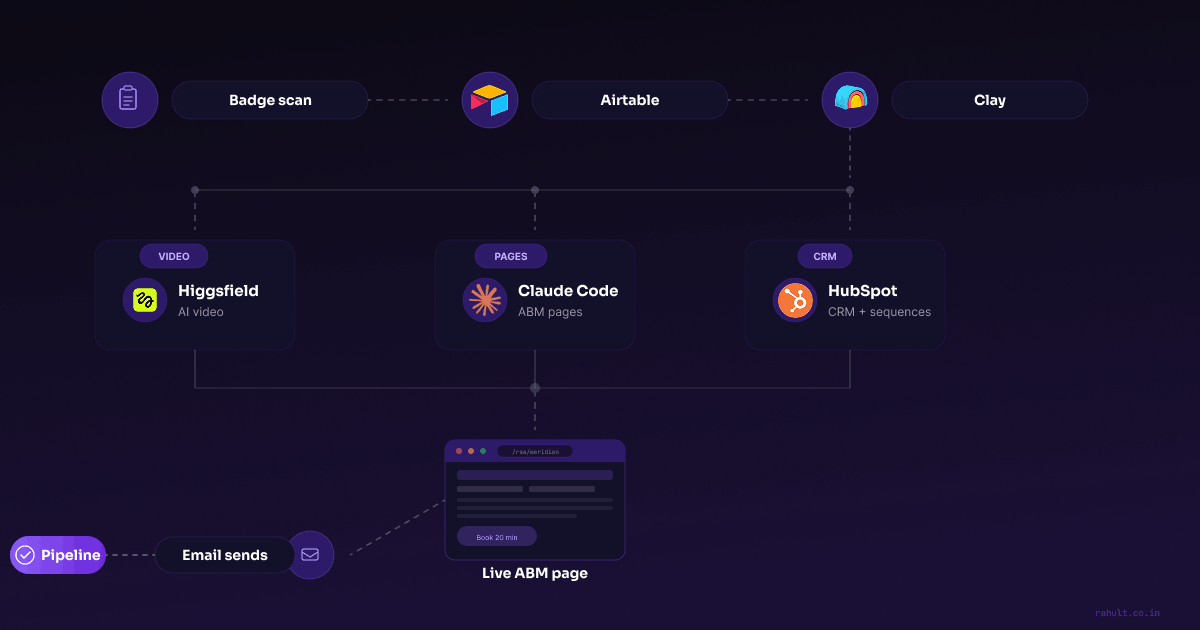
The Swag-to-Story Framework
Five layers. Each one builds on the last.
Let me walk through each one.
Layer 1: The Capture
Everything starts at the booth. But not with a badge scan. With an intentional interaction.
The Setup
Your rep doesn't just hand out swag randomly. They make a deliberate choice based on who they're talking to.
Security Engineer complaining about alert fatigue? They get Swag A (Headphones). CISO talking about board pressure? They get Swag B (3AM Kit).
The swag selection IS the segmentation. No AI classification needed later. The human makes the call in the moment.
The Form
After handing over the swag, the rep fills a quick form on an iPad. Takes 30 seconds.
Badge Scan Data (auto)     → First Name, Last Name, Email, Company, Title
Swag Given (dropdown)      → Swag A: Headphones / Swag B: 3AM Kit
Conversation Notes (text)  → Free text, capture the pain point
Interest Level (dropdown)  → Hot / Warm / Cold / General / Influencer
Cloud Providers (optional) → AWS / Azure / GCP / Multi-cloud
Current Tools (optional)   → "Using Prisma Cloud" / "Evaluating Wiz"
Rep Name (dropdown)        → Mike / Priya / James / Sarah
Tally or Typeform (iPad form) → Webhook → Airtable (new row created)
This is the only manual step in the entire workflow. Everything after this is automated.
Layer 2: The Segment
The moment a row lands in Airtable, Clay picks it up and starts enriching.
What Clay Adds Automatically
Company Logo       → Clearbit
LinkedIn Photo     → Clay People Enrichment
Employee Count     → Clay Company Enrichment
Industry           → Clay Company Enrichment
Funding Stage      → Clay Company Enrichment
Tech Stack         → BuiltWith or Clay
Company Slug       → Formula: lowercase, hyphens
Now you have context. Not just "Sarah Chen from Acme Corp" but: Acme Corp has 2,400 employees, they're Series D in Financial Services, running AWS and Kubernetes, and Sarah is a Sr. Cloud Security Engineer.
Airtable (new row) → Clay (enrichment runs) → Airtable (row updated with enriched data)
Layer 3: The Score
Not every lead is equal. And not every lead should get the same follow-up.
The Scoring Model
Swag B: 3AM Kit (decision maker)         → +30 points
Swag A: Headphones (practitioner)        → +15 points
Interest Level: Hot                       → +40 points
Interest Level: Warm                      → +20 points
Interest Level: Influencer                → +25 points
Title contains CISO/VP/Director           → +25 points
Title contains Engineer/Architect         → +10 points
Company Size: 1000+ employees             → +20 points
Notes mention "evaluating" or "replacing" → +30 points
Notes mention "breach" or "incident"      → +30 points
Lead Categories
Category     → Score   → What It Means
─────────────────────────────────────────────────────
Hot          → 80+     → Ready to buy. Book demo now.
Warm         → 50-79   → Interested but not urgent. Nurture.
Cold         → 20-49   → Low engagement. Stay in touch.
General      → Any     → Not ICP. Add to community.
Influencer   → 40+     → Not decision maker, but can champion.
CTA Mapping
Category     → CTA                  → Destination
─────────────────────────────────────────────────────────
Hot          → Book Demo            → Rep's Calendly
Warm         → Watch Product Video  → Gated 3-min video
Cold         → Download Report      → Ungated PDF
Influencer   → Get One-Pager        → Ungated PDF
This is where I'd normally keep going.
But the full build — every prompt, every Airtable formula, every Clay workflow, the Claude Code commands to generate and deploy the pages, the video creation prompts, the cost breakdown — that's a lot.
So I packaged it.
The Complete Swag-to-Story Build Kit — everything you need to go from "conference swag idea" to "automated ABM page live in 48 hours."
It's free. I just want to know who's building this stuff.
Get the Build Kit →Layer 4: The Page
This is where it gets fun.
Most ABM pages are boring. Name, logo, generic copy. "Hi {first_name}, thanks for stopping by our booth!"
Nobody reads that. Nobody remembers that.
Here's what makes this different.
The Video Hook
When the page loads, the first thing they see is a 5-second AI-generated video.
A friendly face — your rep character — holding the actual swag item they picked up (Swag A or Swag B). Looking directly at them. Then saying:
"Finally. Silence." (for Swag A) "For the night you don't get the call." (for Swag B)
Five seconds. Personalized. Impossible to ignore.
I used Higgsfield to generate these videos from reference images. The full prompts — character creation, LinkedIn headshot, scene-by-scene video storyboard — are all in the Build Kit.
The "We Heard You" Block
Below the video, there's a card that shows the conversation notes the rep captured. Word for word.
"Drowning in Prisma Cloud alerts. Team of 4, supposed to be 7.
Contract up in Q3, looking at everything."

— captured by Mike at Booth #1247
This is the moment they realize: this isn't a template. Someone actually listened. Someone built this for them.
Here's What the Swag A Page Actually Looks Like
I built a working example. This is the page that would go to Sarah Chen at Meridian Financial — a Security Engineer who picked up the Headphones (Swag A) at the booth:
Everything on that page — the stats, the callout copy, the CTA — is generated from the data captured at the booth and enriched by Clay. The Claude Code script parses the Airtable record and builds the HTML automatically.
The Dynamic CTA
Based on their lead category, the CTA changes. Hot leads get a Calendly link. Warm leads get a product video. Influencers get a one-pager to share with their team.
Clay (enriched + video URL) → Claude Code (page generated) → Vercel (deployed)
→ Live at yoursite.com/rsa/acme-corp
Layer 5: The Send
The page is live. Now it needs to land in their inbox.
Timing: Next morning. 7:30am local time. While they're grabbing coffee before Day 2 of the conference. They're still at RSA. Badge still around their neck. Your booth is still fresh.
Sender: Not marketing. Not "The Team at [Company]." The email comes from the rep who handed them the swag. The person they actually talked to.
Email for Swag A (Headphones)
Subject: The headphones weren't random, Sarah

Hey Sarah,

Good talking at the booth yesterday.

I put together something for you — explains why we handed
you the headphones and how it connects to what you mentioned
about Prisma Cloud.

[yoursite.com/rsa/meridian-financial]

Takes 2 minutes. Has a short video too.

– Mike
Email for Swag B (3AM Kit)
Subject: For the night you don't get the call

Hey James,

Great meeting you yesterday.

I put together a quick page — the story behind the
3AM Kit and why I think it matters for what you're
building at Fortify Corp.

[yoursite.com/rsa/fortify-corp]

Short read. Starts with a video.

– Priya
HubSpot (owner assigned) → Slack notification (#rsa-leads) → Rep sends from HubSpot sequences
The Real Unlock
Everyone at RSA is trying to be memorable. Clever swag. Big booths. Celebrity appearances.
But memorable doesn't mean pipeline.
Pipeline happens when you take the moment you created at the booth and extend it. When the prospect opens their email the next morning and sees something that feels like it was made just for them. When they watch a video that says their name. When they read their own words reflected back at them. When the CTA matches where they actually are in their buying journey.
That's the unlock.
Everyone's fighting to win the booth. The real game is winning the morning after.
What would you add to this framework? Anyone else building swag-to-ABM workflows? I'd love to see what you're experimenting with →
This is The Build. I document what I'm building, where it breaks, and what I'm learning along the way.